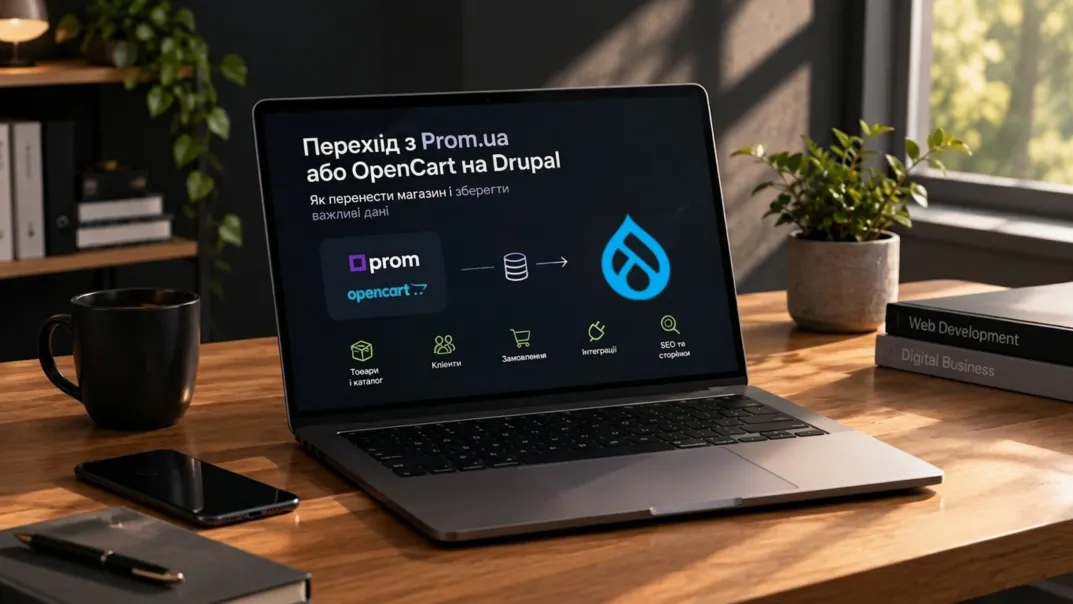
Migrating from Prom.ua or OpenCart to Drupal: How to Move Your Online Store Without Losing Important Data
Migrating from Prom.ua or OpenCart to Drupal is an opportunity not just to change platforms, but to build an online store with greater capabilities to support your business operations. However, the new website must do more than provide the required functionality. It must also preserve everything valuable from the old store: products, orders, customer data, integrations, and the pages that bring in buyers.
There is an important nuance here: Prom.ua and OpenCart offer different levels of access to data and settings, so the migration approach differs as well. What can be transferred to Drupal, what will need to be configured from scratch, and how can you organize the migration while your store continues to make sales? Let's take a closer look.
When Should You Migrate, and When Is Further Development Enough?
Changing your CMS to add a single new feature is not always worthwhile. If the feature can be implemented properly in your existing store, extending the current system is the simpler option.
However, when every change requires a workaround—for example, to set separate prices for dealers, introduce order approval workflows, or exchange data between departments—it is worth comparing the ongoing cost of modifications with the cost of developing a new system.
With Drupal, you can build an online store tailored to these processes and continue adding the functionality you need. If migration really makes sense, the first step is to assess the existing platform: what it allows you to transfer and in what format.
Migrating from Prom.ua and OpenCart: What's the Difference?
From Prom.ua: First, Check Which Data Is Available
Prom.ua is a hosted service, so not all store data and settings are accessible in the same way as they are in a self-hosted CMS. Before planning the migration, we check what can be exported.
According to Prom.ua's documentation, products and product groups can be exported in tabular formats or YML, while orders can be exported to XLS or XML where these options are available. However, the available data depends on the settings and export capabilities. That is why we need to examine not just the file itself, but the exact fields it contains and whether they are sufficient for the new store.
The store's domain is equally important. If the store uses a custom domain, we check access to its settings and plan the switch. If its pages use Prom.ua URLs, those URLs cannot simply be transferred to another domain. Therefore, the options for preserving search traffic must be assessed before development begins.
From OpenCart: Check the Database and Installed Modules
OpenCart is an open-source platform. If we have access to the hosting environment, files, and database, we can examine the store's structure and prepare a migration that accounts for its specific configuration.
However, two OpenCart stores can be very different. One may run almost entirely on standard functionality, while another may rely on dozens of modules, custom fields, and modified order-processing logic. We therefore start by determining where the required data is stored and how the different elements are related, then create backups of the files and database.
In other words, with Prom.ua, we first determine what can be exported and who owns the store's domain. With OpenCart, we examine the database structure and identify which modules affect the store's operation. These factors determine which data can be transferred and what will need to be configured again.
Which Data Can Be Transferred, and What Must Be Recreated?
After assessing the existing platform, we compile a list of everything the new store will need. Some data can be transferred directly, some must be adapted to Drupal's structure, and integrations need to be connected again.
Data in the Existing Store | What We Do During the Migration to Drupal |
| Products and catalog | Transfer available product names, SKUs, prices, images, specifications, variations, and stock levels. Verify categories, brands, and relationships between products. |
| Customers | Check which contact details, addresses, and history are available. Assess the possibility of transferring user accounts and login methods separately. |
| Orders | Transfer the agreed order history, including statuses and available payment and shipping information. |
| Integrations | Reconnect and test CRM, ERP, warehouse systems, payment services, shipping services, and other tools. Existing settings cannot simply be copied into Drupal. |
| Pages and SEO data | Preserve the required content and metadata. For important URLs, determine in advance whether the original addresses can be retained or redirects can be configured. |
Copying everything exactly as it is does not always make sense. Outdated records can be archived, duplicates removed, and an inconvenient catalog structure redesigned. The important thing is to agree on these decisions before the migration begins, so essential data is not lost among records that are no longer needed.
What About New Orders During Development?
While we build the Drupal website, the existing store can continue making sales. During this time, stock levels and prices change, and new customers and orders appear. This means that a single export at the beginning is not enough.
That is why we plan a test migration to validate the data and a final update before launch. We also determine how to handle orders placed between these stages and how to prevent duplicates. If a short pause is needed to switch systems, we agree on it in advance. There is no need to shut down the existing store for the entire development period.
How We Organize the Migration to Drupal
Once we know what data is available and how the store will operate during the migration, we create a step-by-step development and launch plan.
1. Analyze the Existing System and Create a Plan
We bring everything together in one plan: which features to retain, what to change, which data to transfer, and how to verify the results. We also document important URLs and confirm access to the domain. These details should be addressed before building the new store.
2. Design the Store Around Your New Business Requirements
We plan the catalog structure, filters, customer accounts, pricing rules, and checkout process. At this stage, we determine what needs to be recreated and what should be improved. This ensures that the new website does not inherit inconvenient solutions simply because they existed in the old store.
3. Build a Test Version and Migrate the Data
We configure Drupal, perform a test import, and compare the results with the original store: SKUs, images, specifications, categories, customers, and available orders. For migrations from different sources, we can use the Drupal Migrate API, although the specific method depends on the structure of the source data.
4. Restore Integrations and Test the Sales Process
We connect the CRM, ERP, warehouse system, payment services, and shipping services. Then we test the complete workflow rather than checking each service in isolation: a customer places an order, the payment is processed, the data reaches the accounting system, stock levels are updated, and the manager can see the current order status. Examples of these integrations are available on the GL.ua Features page.
5. Prepare URLs and SEO Data
Using a list of important pages, we check which URLs will remain unchanged and where redirects can be configured. We transfer the required content and metadata and check internal links. Pages hosted on Prom.ua URLs offer different options from those on a store's own domain.
For more information about redirects, indexing, and monitoring traffic after launch, read our article Website Redesign and Migration Without Losing SEO. It is important to remember that even careful preparation cannot guarantee that Google rankings will remain completely unchanged.
6. Perform Final Checks and Launch the Store
Before switching over, we check that everything is ready for real sales:
- Products, categories, and specifications have been transferred correctly.
- The agreed customer data and order history are available.
- A test order can go from the cart through payment, shipping, and accounting.
- There is a clear plan for applying the final changes from the old store.
- Important old URLs have been checked, and the necessary redirects are ready.
- Responsibility for monitoring the store after launch has been assigned.
Before launch, we restrict access to the test version and prevent search engines from indexing it. Once all checks are complete, we perform the agreed final data update and switch over to the new store. After launch, we monitor orders, page availability, and data exchange between systems.
What Determines the Timeline and Cost?
The scope of work becomes clear when we look at the catalog, for example. A store with standard products and an available export is easier to migrate than a system with custom OpenCart modules, multiple languages, complex pricing rules, and integrations.
We therefore estimate data migration, the development of required features, design, integrations, and testing separately. If the store structure and sales rules also need to change, the project is effectively the development of a new online store combined with data migration, rather than a simple CMS switch. We provide more information about estimated project timelines on our Timelines page.
Let's Start with Your Existing Store
Planning to migrate from Prom.ua or OpenCart to Drupal? Show us your current store and tell us what you want to improve: the catalog, pricing for different customer groups, integrations, or the checkout process.
At GL.ua (Glyanets), we specialize in developing Drupal-based online stores. We will assess which data can be transferred, what needs to be rebuilt, and propose a migration plan tailored to your business requirements.
Is it necessary to change the design along with the platform?
No. You can keep the visual concept familiar to buyers and update the technical part first of all. But the templates and functionality themselves will have to be implemented under Drupal — automatically transferring the design from the old CMS usually won't work.
What if part of the data cannot be exported?
First we find out what data the new store really needs. For part of the information, another method of transfer, manual recovery or archive can be provided. If the data is not in an accessible format, we do not promise to transfer it without loss - we determine the limitations before the work begins.
Can I leave Prom.ua after launching my own store?
Yes, you can use Drupal store and Prom.ua as separate sales channels. But the synchronization of goods, prices, balances and orders must be thought out separately: the possibilities depend on the available tools and the desired work scheme.
Will buyers be able to use their old accounts?
It depends on the data accessed by Prom.ua or OpenCart and the way passwords are stored. Sometimes profiles and order history can be transferred, but customers will need to set a new password to log in. Such a scenario must be anticipated before launch.
Just one step to your perfect website