Turnkey online store development: stages, cost, and what affects the price in 2026


The market has reached a stage where the buyer does not give a second chance. If your site takes longer than three seconds to load, filters work with a delay, and the checkout process requires extra effort — the client goes to a competitor. In such realities, the creation of an online store ceases to be an exclusively technical task. It is a process of building a complex, multi-level business system that must work flawlessly, generate stable profit, and scale without the constant intervention of the owner.
Today, entrepreneurs often look for information upon the query "creation of an online store", expecting to find a simple solution or a ready-made template. However, real success in eCommerce lies in deep analytics, the right choice of technological stack, and the integration of advanced automation systems even at the foundation stage.
In this article, we will analyze in detail what full-cycle development means, how online store development happens from the first prototype to the final release, which technologies determine market leaders, and how much an online store costs in the current realities of digital business.
What is turnkey online store creation
The concept of "turnkey" means the complete delegation of responsibility for the final product to a single team of professionals. You come to the studio with an idea or business model, and at the output, you receive a fully working, tested, and configured sales tool that is immediately ready to accept the first clients.
Effective creation of a turnkey online store excludes situations where you are forced to independently coordinate the work of a designer, programmer, security specialist, and SEO optimizer. All work is done inside the studio under the strict control of a Project Manager and business analyst.
What is included in this format:
Comprehensive niche audit: We study your competitors and target audience to offer the best UX (user experience).
Unique design (architecture): Development of a catalog architecture that will withstand hundreds of thousands of product items without loss of speed.
Custom design: Creation of a visual style that broadcasts trust and emphasizes the premium nature of your product.
Backend and integrations: Setup of the server part, connection of CRM, warehouse accounting, payment systems, and delivery services.
End-to-end automation: Implementation of AI agents and scenarios for messengers.
Ordering a turnkey online store, you invest not just in web pages, but in your own digital asset, which becomes the main engine of your sales.
Development stages — from idea to launch
Professional online store development is a systematic process divided into several strictly regulated stages. Skipping even one of them will inevitably lead to a loss of conversion in the future.
Stage 1. Analytics and architecture design (UX) Any successful creation of online stores begins with logic. Our analysts develop the site structure, guided by the golden "4 clicks rule". The client's path from the main page to a successful payment must be intuitive and as short as possible. We design the category tree, develop a system of smart filters, and create cross-sell logic.
Stage 2. UI design and visual content In 2026, the design must be not only adaptive (Mobile First) but also maximally focused on quality content. The visual directly affects the purchase decision, because modern design sells through emotion and detailing.
Stage 3. Programming and technical implementation (Backend) At this stage, the design turns into fast and secure code. We use modern frameworks and reliable systems (such as a flexible architecture based on Drupal). A database is set up, an admin panel is developed that will allow your managers to easily manage products without knowledge of code.
Stage 4. Integrations and AI automation (GL.ua Exclusive) This is the stage that turns a regular catalog into an autonomous machine. Mass development rarely reaches this level, but for us, it is a standard:
Automation on n8n: We set up data exchange scenarios. Your order instantly gets into Notion or 1C, a TTN is generated, and the client receives a status in Telegram.
Autonomous AI secretary: We integrate smart bots (like our signature agent Alisa), which are capable of replacing the first line of support. The bot conducts a dialogue in Ukrainian, closes objections, and transmits a clear report on the work done to the manager.
Audio marketing: For VIP clients, we can set up automatic outbound call systems via Twilio, using the most advanced voice models (ElevenLabs v3), which generate live, energetic speech to confirm orders or offers.
Stage 5. Testing (Pentesting) and SEO base Before launch, the site undergoes rigorous load tests and a cybersecurity audit. Our specialists check the system for vulnerabilities using professional environments to guarantee the absolute security of your clients' payment data. Simultaneously, technical SEO is set up: clean URLs, Schema.org micro-markup, load speed optimization.
What affects the cost (functionality, design, CMS)
When entrepreneurs search for the query "online store creation price", they often see a colossal gap in numbers. Why does this happen? The cost is formed from several key factors.
1. Choice of platform (CMS) and architecture
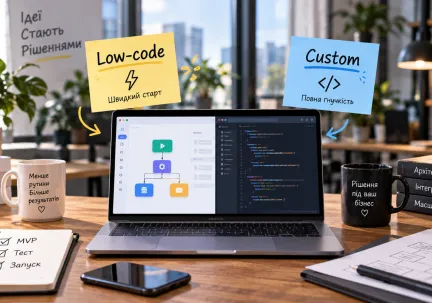
SaaS solutions (builders): The cheapest option, but you do not own the code and are strictly limited in scaling.
Open Source CMS: Middle price segment. Requires buying many plugins and constant technical maintenance.
Custom / Enterprise (Individual development): The highest cost at the start, but it guarantees absolute flexibility, the highest speed, and the ability to implement complex business models (for example, MRR — Monthly Recurring Revenue for selling subscriptions).
2. Complexity of design Template design costs little but does not distinguish you among competitors. Individual UX/UI, created based on deep analytics of your target audience's behavior, drawing unique icons, creating 3D product models, or complex animations — all this requires dozens of hours of work by leading designers.
3. Functionality and integrations A basic cart and card payment is a standard. But if you need a complex bonus system, a personal account for B2B clients with different price columns, real-time integration with several warehouses, notification automation in WhatsApp, and deployment of AI agents — the volume of programming grows exponentially, which directly affects the budget.
How much does it cost to create an online store in 2026
Answering the popular question about the budget, it is important to understand the main rule: in the eCommerce sphere, there are no fixed prices. Every business is unique, so the cost is calculated strictly individually.
The budget directly depends on your needs, the complexity of the architecture, and the number of integrations. To make it easier for you to navigate, we divide projects into three main levels of complexity:
Basic format (Start). An ideal solution for a local business or monobrands that need a quick and quality market entry. The budget of such a project is formed taking into account the development of adaptive design based on reliable CMS, setting up the catalog logic, connecting online payment systems, integrating standard delivery modules, and basic SEO optimization.
Optimal business format. A solution for actively scaling companies that need deep process synchronization. The cost is calculated individually based on the development of a unique UX/UI design projected from scratch, the creation of an advanced multi-level filter system, full integration with CRM systems (Bitrix24, KeyCRM, etc.), warehouse accounting setup, and the implementation of basic automation (for example, via n8n scenarios).
Enterprise platforms and Ecosystems. This is flagship platform creation for large retail and extensive B2B portals. Project estimation includes complex custom developments: integration and training of autonomous AI secretaries, implementation of monthly subscription billing systems, ensuring the maximum level of cybersecurity, and deep customization of all client business processes.
We form the exact estimate of your project exclusively after a detailed audit.
Why you should choose GL.ua
Today it is not enough just to write code. The winner in the market is the one who processes information faster, understands the client better, and spends fewer operational resources on routine.
The team of the GL.ua web studio is not just developers. Our leading business analysts and Project Managers build full-fledged digital ecosystems. We are proud that:
We do not use template solutions that limit your development.
We are automation specialists. The implementation of server scenarios on n8n and AI integration allows our clients to reduce personnel costs by up to 40%.
We are focused on your financial metrics. Our design is projected to sell quickly, following the rule of a minimum number of clicks.
We take full responsibility — from the first audit to final vulnerability testing.
Frequently Asked Questions (FAQ)
1. How long does it take to create a turnkey online store? On average, the development of a high-quality project takes from 2 to 4 months. Everything depends on the complexity of integrations (with ERP, CRM) and the volume of the product nomenclature. The process is divided into transparent sprints, and you constantly monitor the progress of the work.
2. Can I start with a basic site and then add AI bots and complex integrations? Yes, if the architecture is laid correctly from the very beginning. We always develop sites with an eye on future scaling, so you can easily add new modules when the business grows.
3. Is SEO promotion included in the development cost? The development cost includes basic SEO optimization: correct heading hierarchy, sitemap generation, robots.txt setup, micro-markup, and high load speed. For further bringing the site to the TOP-10 of Google, we offer a separate service of comprehensive content marketing and SEO promotion.
4. Will I be able to change prices and add products myself? Undoubtedly. You will receive an intuitive control panel. We also conduct training for your employees, so daily catalog management will not require the involvement of programmers.
Want to become the undisputed leader in your niche? Entrust the technical implementation of your business to professionals. Leave a request on the GL.ua website, and our business analysts will audit your project, propose the best technological solutions, and prepare a transparent estimate!
Just one step to your perfect website