How LMS systems transform learning in companies and businesses


LMS system: knowledge that works for your business
Imagine a typical situation familiar to many companies. A new employee joins you. You carefully prepare a starter kit for him: dozens of Google documents, several video tutorials, links to files in the cloud, notes in Notion, and verbal explanations from a colleague. It seems that you have everything covered. But after a few days, it turns out that the newcomer does not understand where to start, confuses priorities, and asks questions that supposedly already have answers. The result is wasted time, mistakes, and losses.
This is a typical example of how a systemless approach to learning is becoming a shadow problem for business . That is why more and more companies are turning to LMS — Learning Management System. This is not just a trendy piece of software, but a centralized platform for knowledge management in the organization , which allows you to take training, onboarding and team development to a new level.
LMS is a kind of "internal university" of the company. It stores all the training materials, interactive courses, instructions, tests, certifications. This is a place where any employee can quickly find the answer to their question, take a course, update their knowledge or check their level. And the manager can see the real picture: who is learning, what and how, what are the results, where reinforcement is needed.
Why are companies increasingly implementing LMS? Because the traditional learning model no longer works. People don't read long instructions, don't memorize by ear, don't return to entries in messengers. At the same time, the need for constant knowledge updating is growing. Technologies are changing, products are developing, teams are scaling. And in order not to lose quality, a business must have control and structure in the learning process .
Thanks to LMS, you can train employees at all stages: from the first day to a management position. Such systems unify work standards between departments, ensure knowledge is preserved even when personnel changes, and save time for HR specialists and internal trainers. Everything that previously had to be done manually — checking tests, reminding about deadlines, looking for who to send materials to — is now done automatically.
LMS is equally effective for corporations, educational institutions, online schools, consulting agencies, or internal HR departments. The versatility of the system allows it to be adapted to any industry - from sales and technical support to healthcare, IT, or manufacturing.
A modern LMS system is not just a knowledge library. It is a platform that supports videos, texts, interactive SCORM modules, has built-in tests, gamification, and certification. It automatically generates statistics: who completed the courses, how quickly, and where difficulties arose. This is especially useful for analyzing learning effectiveness, comparing teams, and identifying growth points. And additional features — such as badges, leaderboards, and progress bars — motivate the team to learn more actively.
Scalability is especially important for many businesses: an LMS allows you to train thousands of users simultaneously without losing system stability. And thanks to integrations with CRM, HRM, messengers or calendars, training is built into familiar workflows without additional effort.
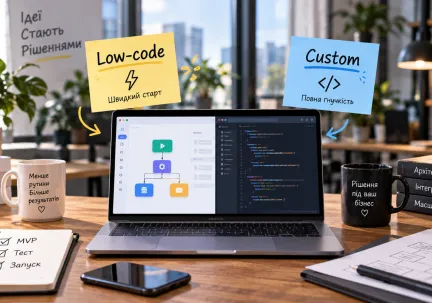
As for implementation, it usually takes place in several stages. First, the company's needs are analyzed, typical usage scenarios are determined. Then the optimal platform is selected: it can be a ready-made solution (such as Moodle, TalentLMS, iSpring Learn) or individual turnkey development. The next step is to create educational content, launch the first courses, train the team, and provide technical support.
We at Glyanets work with LMS not as software developers, but as system integrators . We implement ready-made solutions or create customized platforms adapted to your brand, business logic, corporate culture. Our LMS have a simple, clear interface, without unnecessary buttons and complexities, which allows teams to easily start using it without a long training.
A strong LMS is not just a convenience. It’s a competitive advantage . A company that has a structure for learning moves faster, trains new employees more effectively, maintains standards, and easily transfers expertise internally. The result is fewer mistakes, more confidence, and better results.
Conclusion
In the digital age, knowledge is capital. And an LMS is the tool that makes it manageable, accessible, and useful for business. If you want to take your team to the next level, streamline training, and gain real control over your staff development, an LMS will be your best ally .
Do you want to implement an LMS in your company?
The Glyanets team will select the optimal solution, adapt it to your business, and implement the project in practice — quickly, effectively, and taking into account your goals.
LMS is about control, efficiency, and growth. We can help you achieve this in your company.
Just one step to your perfect website