Online store development: technology evolution, timelines, and real investments in 2026


Modern e-commerce resembles Formula 1 racing: the winner is not the one who simply has a beautiful car, but the one whose infrastructure works fractions of a second faster and collects more accurate data. In 2026, users do not notice technologies, but they instantly feel their absence. A long loading of the catalog, a failure during payment via Apple Pay, or a discrepancy between real balances and the numbers on the site — and the client closes the tab forever.
Today, the decision to create an online store means launching a complex IT infrastructure. Monolithic sites of the past decade, where the frontend and backend were tightly glued together, are giving way to flexible microservice architectures. Business demands systems capable of withstanding peak loads on Black Friday and automatically managing hundreds of processes.
In this article, GL.ua experts analyze which architectural solutions dominate the market, how modern online store development differs from classic ones, how real launch timelines are formed, and how the Total Cost of Ownership (TCO) of the product is calculated.
Technological stack 2026: Headless Commerce and microservices
The main trend that completely changed the approach to eCommerce is the rejection of heavy monolithic systems. If you are planning a large-scale project, online store development must be built on the principles of Headless Commerce and an API-first approach.
1. Headless Commerce: speed without compromises The essence of the Headless approach is the physical separation of the visual part of the site (frontend) and the server business logic (backend). They communicate with each other exclusively via API. What does this give to the business? You can have an ultra-fast interface written on modern frameworks (Vue.js or React), while the database and payment logic are securely hidden on protected servers. This allows pages to load instantly on smartphones, which critically affects mobile conversion.
2. Microservice architecture (FastAPI and Python) Instead of one system being responsible for everything, enterprise-level online store development involves the use of microservices. For example, the search module works independently of the cart module. If one element is overloaded (say, mass parsing of competitor prices or dynamic pricing, which we often implement on the fast FastAPI with Python), the rest of the site continues to work perfectly smoothly.
3. PWA (Progressive Web Apps) A modern online store should function as a native application on a phone. PWA technology allows the user to "install" the site on the main screen of the smartphone in one click, receive push notifications, and browse the catalog even with an unstable internet connection.
Next-generation CMS: how to choose a platform
When online store development is discussed, the issue of choosing a content management system remains one of the most acute. In 2026, we are moving away from classic out-of-the-box solutions that limit flexibility.
Classic CMS (Monoliths): Solutions where the database, logic, and design are closely tied. Suitable for small niche projects where complex integration with third-party ERP systems is not expected. Their main disadvantage is the difficulty of scaling under high loads.
Headless CMS: This is strictly a content repository with a powerful API. An ideal choice for an omnichannel business. You upload the description and 8K photo of the product once, and the system automatically distributes this content to your site, to the partner's mobile app, to the screens of the offline store, and to the Telegram bot.
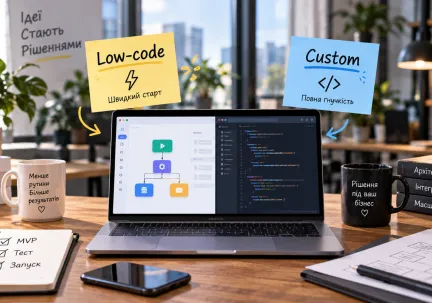
Custom Ecosystems (GL.ua Solutions): For medium and large businesses, we design custom control panels. We deploy the infrastructure through Docker containers, which guarantees perfect system operation on any servers. The administrator interface is created for your specific tasks: nothing extra, only those dashboards and modules that your managers actually use.
Real timelines: Agile sprints instead of chaos
Professional eCommerce development is not creating a landing page in a week. It is an engineering process. To make the launch predictable, we at GL.ua break the work into short iterations (sprints), which allows the business to see the result at every stage.
Sprint 0: Discovery & Architecture (2-3 weeks). Requirement gathering, process audit, writing technical documentation. Defining database structures and designing UX paths (Customer Journey Map).
Sprint 1-2: Core Backend & UI Design (4-6 weeks). Development of server logic, setup of development environments. In parallel, designers draw and approve layouts with a focus on the mobile experience.
Sprint 3: Frontend and Integrations (3-4 weeks). "Reviving" the design and connecting it to the backend via API. Synchronization with 1C/BAS, payment gateways, logistics APIs (Nova Poshta, etc.).
Sprint 4: n8n Automation and AI (2-3 weeks). Setting up invisible processes. Writing scripts in n8n for data exchange between tools. Training and deploying autonomous AI agents.
Sprint 5: QA testing and Release (2 weeks). Load testing (simulating thousands of simultaneous visitors), cybersecurity check, and smooth migration to the working (Production) server.
In general, launching a powerful system takes from 3 to 5 months of purposeful work by a whole team.
Budget and TCO (Total Cost of Ownership)
When a business analyzes the market, the issue of price is always acute. However, assessing the project cost solely by the "launch" budget is a strategic mistake. In 2026, smart investors calculate the TCO (Total Cost of Ownership) of the product over 2-3 years.
A cheap monolithic site may seem profitable today, but tomorrow it will require colossal budgets for constant "treatment" of the database, paying content managers due to an inconvenient admin panel, and losing profit from technical failures.
We at GL.ua profess the principle of transparent investments. Your budget is formed individually and depends on:
Choice of architecture: Headless solutions require larger investments at the start, but are several times cheaper to scale.
Depth of integrations: Complex two-way exchange with non-standard ERP systems requires additional hours from backend developers.
AI automation: Implementation of tools that replace live managers (smart bots, automatic ticket systems) is evaluated separately, but pays off the fastest by reducing the payroll of the support department.
You pay for an engineering solution that minimizes manual labor and withstands any peak loads.
GL.ua cases: how technologies transform business
We are proud of projects that push the boundaries of what is possible in eCommerce:
Case of a B2B auto components portal: The task was to develop a catalog of over 2 million SKUs with an instant VIN code search. The use of traditional CMS led to the "crash" of the database. We designed a Headless architecture using ElasticSearch. Result: the search response speed was less than 0.3 seconds, and the platform conversion increased by 55%.
AI integration in premium retail: For an elite goods boutique, we developed not just an online store, but a digital ecosystem. In the center of communication, we implemented our AI agent — Alisa. She works autonomously in Telegram and on the site: advises VIP clients, analyzes their purchase history, and through n8n automatically reserves goods in the warehouse, passing to managers only final confirmations for payment.
Move to a new level of e-commerce
Today, your site is a showcase, a seller, and a back-office all rolled into one. Success online is impossible without deep technical expertise, correct microservice architecture, and advanced process automation.
The team of experts, engineers, and analysts of GL.ua is ready to become your guide to the world of high technologies. We do not stamp out sites — we develop stable, scalable business systems that work proactively.
Ready to leave competitors with their slow sites far behind? Leave a request for a deep technical consultation today. We will analyze your tasks, select the ideal technological stack, and create a platform that is guaranteed to increase your profit in 2026!
Just one step to your perfect website